
Choosing the right air compressor for your framing nailer can make or break your project. Whether you are building a house, framing a wall, or working on a DIY shed, the combination of air compressor and framing nailer is essential. Many people think any compressor will do, but there are hidden challenges. If you pick a model too weak, your nailer will misfire or slow down. Too large, and you waste money or struggle with heavy equipment. This review explores everything you need to know to select the best air compressor for framing nailers—no matter your experience level.
What Makes A Good Air Compressor For Framing Nailer?
Let’s start with the basics. A framing nailer is a powerful tool that drives large nails into wood quickly. But it needs a steady supply of air at the right pressure. Not all compressors can do this.
Key factors to consider:
- CFM (Cubic Feet per Minute): This shows how much air the compressor can deliver. Most framing nailers need at least 2 CFM at 90 PSI.
- PSI (Pounds per Square Inch): This is the pressure. Framing nailers usually work best at 90–120 PSI.
- Tank size: A larger tank (4–6 gallons or more) means longer work time before the compressor refills.
- Portability: If you move around job sites, weight and handles matter.
- Noise level: Quieter compressors are better for indoor or residential work.
- Duty cycle: Some compressors can run longer without overheating.
Many beginners focus only on PSI, but both CFM and tank size are just as important. Also, not all “pancake” compressors (flat, round tank) have enough power, and not all “hot dog” (cylindrical) styles are weak.
Types Of Air Compressors For Framing Nailers
Choosing the right type helps you balance power, size, and cost.
- Pancake Compressors
- Flat, round tank
- Usually 4–6 gallons
- Lightweight and portable
- Good for single nailers
- Hot Dog Compressors
- Cylindrical tank
- Often 1–4 gallons
- Very portable, but less air storage
- Best for small projects
- Twin-Stack Compressors
- Two tanks stacked
- 4–8 gallons
- More air and power, still portable
- Great for two framing nailers at once
- Wheelbarrow Compressors
- Larger, with handles and wheels
- 8–12+ gallons
- High power, heavy, for big crews
- Stationary Compressors
- Not portable
- 20+ gallons
- For professional shops
Most home users and contractors choose pancake or twin-stack compressors for framing.
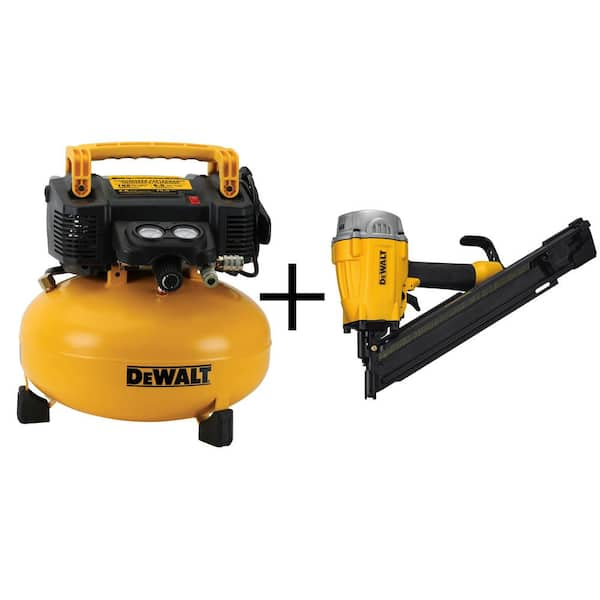
Credit: www.homedepot.com
Top 7 Air Compressors For Framing Nailers Reviewed
Let’s look at some popular compressors that work well with framing nailers. Each one has unique strengths and trade-offs.
1. Dewalt Dwfp55126 6-gallon Pancake Compressor
This model is well-known on construction sites. It has a 6-gallon tank and delivers 2. 6 CFM at 90 PSI—enough for most framing nailers.
- Pros: Lightweight (30 lbs), quiet operation (75.5 dBA), quick recovery time
- Cons: Not ideal for two nailers running nonstop
- Best for: Homeowners, remodelers, and job sites with one framing nailer
2. Bostitch Btfp02012 6-gallon Pancake Compressor
A direct competitor to DeWalt, this pancake compressor is very popular.
- Pros: High flow regulator, 2.6 CFM at 90 PSI, only 29 lbs
- Cons: Slightly louder (78.5 dBA)
- Best for: DIYers, home framing, light contractor use
3. California Air Tools Cat-4710sq 4.7-gallon Ultra Quiet
If noise is your biggest concern, California Air Tools makes some of the quietest compressors.
- Pros: Only 60 dBA, oil-free pump, 4.7-gallon tank, 2.0 CFM at 90 PSI
- Cons: Slightly lower CFM, so not ideal for two nailers
- Best for: Indoor work, noise-sensitive areas
4. Makita Mac2400 Big Bore 4.2-gallon Twin Stack
Makita’s “Big Bore” design means more air with less noise and heat. This model runs at 4. 2 gallons and delivers 4. 2 CFM at 90 PSI.
- Pros: Durable cast iron pump, fast recovery, can handle two nailers
- Cons: Heavier (77 lbs), higher price
- Best for: Contractors, heavy framing, demanding jobs
5. Porter-cable C2002 6-gallon Pancake Compressor
A budget-friendly choice. It offers 2. 6 CFM at 90 PSI and a 6-gallon tank.
- Pros: Inexpensive, easy to carry, reliable for occasional use
- Cons: Louder, not for large crews
- Best for: Homeowners, occasional framing
6. Rolair Fc2002 4.3-gallon Twin Stack Compressor
This model is built for professionals. It puts out 4. 1 CFM at 90 PSI and has a rugged twin-stack tank.
- Pros: Heavy-duty, stable base, great for two framing nailers
- Cons: Heavy (64 lbs), more expensive
- Best for: Professional framing, rough environments
7. Metabo Hpt Ec710s 6-gallon Pancake Compressor
Formerly known as Hitachi, Metabo HPT’s compressor provides 2. 8 CFM at 90 PSI with a 6-gallon tank.
- Pros: Lightweight, strong output, good value
- Cons: Slightly louder than some competitors
- Best for: Homeowners, light commercial use
Comparing The Best Air Compressors For Framing Nailers
For a quick side-by-side look, here’s a comparison of the top models:
| Model | Tank Size (Gallons) | CFM @ 90 PSI | Weight (lbs) | Noise (dBA) | Best Use |
|---|---|---|---|---|---|
| DeWalt DWFP55126 | 6 | 2.6 | 30 | 75.5 | Single framing nailer |
| Bostitch BTFP02012 | 6 | 2.6 | 29 | 78.5 | DIY, home framing |
| California Air Tools CAT-4710SQ | 4.7 | 2.0 | 43 | 60 | Indoor/quiet jobs |
| Makita MAC2400 | 4.2 | 4.2 | 77 | 79 | Professional/dual nailer |
| PORTER-CABLE C2002 | 6 | 2.6 | 34 | 82 | Budget/home use |
| Rolair FC2002 | 4.3 | 4.1 | 64 | 80 | Professional crew |
| Metabo HPT EC710S | 6 | 2.8 | 36.5 | 73 | General framing |
Credit: www.youtube.com
How To Match A Compressor With Your Framing Nailer
A common mistake is buying a compressor based only on tank size or price. But the real match depends on your framing nailer’s air requirements and how you work.
Steps to get the right match:
- Check your framing nailer’s CFM and PSI needs. Most need 2 CFM at 90 PSI, but check the manual.
- Consider how many nailers you want to run at once. For two nailers, double the CFM.
- Think about work style. If you fire nails continuously, you need higher CFM or a larger tank.
- Look at power source. Most job site compressors run on 120V, but some large ones need 240V.
- Decide if you’ll carry it often. Weight and handle design matter if you move a lot.
- Noise matters. For indoor jobs, quieter units are much more comfortable.
Example Scenario
If you are framing a small house with two nailers, you need at least 4 CFM at 90 PSI. The Makita MAC2400 or Rolair FC2002 would be good. For one nailer and occasional use, the DeWalt or Bostitch pancake compressors are enough.
Key Features To Look For
When buying an air compressor for a framing nailer, look for these features:
- Oil-free pump: Less maintenance, cleaner air, but sometimes louder
- Thermal overload protection: Prevents overheating if you use the compressor a lot
- Quick-connect couplers: Makes it easy to attach hoses and switch tools
- Rubber feet or wheels: Reduce vibration, make moving easier
- Easy drain valve: For letting water out of the tank, which prevents rust
Non-obvious insight: Some compressors have dual couplers, so you can use two tools at once without a splitter. This can save time and reduce leaks.
Pros And Cons Of Popular Compressor Types
Let’s compare the main types by their strengths and weaknesses:
| Type | Pros | Cons |
|---|---|---|
| Pancake | Lightweight, portable, affordable | Less air for big jobs, may slow with heavy use |
| Twin Stack | Good air storage, can run two nailers, balanced | Heavier, more expensive |
| Hot Dog | Very portable, compact | Small tank, not for continuous use |
| Wheelbarrow | High power, large tank for crews | Heavy, costly, not for home use |
| Stationary | Unlimited air, for shop use | Not portable, expensive, needs special power |
Air Compressor Maintenance Tips
To keep your compressor working well for years, follow these simple tips:
- Drain the tank after each use. Water collects inside and causes rust.
- Check the air filter. Clean or replace it every few months.
- Inspect hoses and fittings. Look for leaks, cracks, or wear.
- Oil the pump if required. Some models need regular oil checks.
- Run the compressor occasionally. Even if you don’t use it often, running it every month keeps seals fresh.
A common mistake is forgetting to drain the tank. Even a little water inside can damage your compressor over time.

Credit: www.youtube.com
Mistakes To Avoid When Choosing A Compressor
Many buyers focus only on the price or pick a model based on looks. Here’s what often goes wrong:
- Ignoring CFM needs: If your compressor can’t keep up, your nailer will misfire or slow down.
- Choosing too small a tank: Small tanks refill often, which wears out the motor.
- Buying too big: Large compressors are heavy and hard to move, which is a problem for small jobs.
- Overlooking noise: Loud compressors can be a problem indoors or in neighborhoods.
- Skipping maintenance: Even the best compressor will fail without care.
Non-obvious insight: Always check the duty cycle. If you plan to run your compressor for hours, get one with a 50% or higher duty cycle so it can run without overheating.
How To Set Up Your Compressor And Nailer Safely
Proper setup matters for safety and tool life.
- Place the compressor on a flat, level surface.
- Connect the air hose securely. Use Teflon tape for better seals if needed.
- Adjust the regulator. Set it to the PSI your framing nailer needs—usually 90–120 PSI.
- Check safety features. Make sure the relief valve and overload switch work.
- Wear hearing and eye protection. Some compressors are loud, and nailers can misfire.
- Never use a damaged hose. Replace it immediately.
When To Upgrade Your Compressor
If you find your framing nailer is “catching up” (waiting for air) or slowing down, your compressor may be too small. It’s time to upgrade if:
- You add a second framing nailer
- You start bigger jobs, like whole-house framing
- The compressor gets hot or shuts down often
- You need shorter wait times between nailing
Upgrading early saves money in the long run because you avoid tool damage and wasted time.
Real-world Examples
- Homeowner Joe bought a small hot dog compressor for his basement framing. It was fine for a few nails but kept shutting off during long runs. He switched to a 6-gallon pancake model and finished the job faster.
- Contractor Mia used a twin-stack Makita for her crew. She could run two framing nailers all day without pressure drops, saving her team an hour per project.
These examples show that matching the compressor size and type to your real needs is key.
Environmental And Power Considerations
Some job sites have limited electrical outlets or only 15-amp circuits. Always check your compressor’s amperage and voltage. Using a long extension cord can cause voltage drops and damage the motor. If possible, use a heavy-duty (12-gauge or thicker) cord and keep it short.
Modern compressors are more energy-efficient and meet stricter noise rules. If you work indoors or in residential areas, quieter models are a wise investment.
Accessories That Improve Performance
A few simple accessories can make your compressor and nailer setup better:
- High-quality hose: A flexible, kink-resistant hose (like polyurethane) helps prevent leaks and tangles.
- Hose reel: Keeps your work area tidy and protects the hose.
- Moisture filter: Removes water from the air line, which protects your nailer.
- Quick couplers: Let you switch tools fast and reduce leaks.
Price Range And Value
You can find reliable air compressors for framing nailers in these price ranges:
- Entry-level (under $150): PORTER-CABLE, Bostitch—good for light use
- Mid-range ($150–$300): DeWalt, Metabo HPT—best for most users
- Pro-level ($300+): Makita, Rolair—suitable for contractors or two-tool setups
Pro tip: Spending a little more on a well-known brand often means better support and longer life.
Where To Buy And What To Avoid
Buy from reputable stores or authorized dealers. Be careful with used compressors unless you can test them. Many online deals are good, but always check for a warranty.
For more on power tools and air compressors, see the Wikipedia page on air compressors.
Frequently Asked Questions
What Size Air Compressor Do I Need For A Framing Nailer?
For most framing nailers, a compressor with at least 2.0 CFM at 90 PSI and a 4–6 gallon tank is enough for single-tool use. For two nailers or heavy-duty work, look for 4+ CFM.
Can I Use A Pancake Compressor For A Framing Nailer?
Yes, many pancake compressors work well for framing nailers, as long as they provide enough CFM and PSI. They are portable and easy to move, ideal for small crews or DIYers.
Why Does My Framing Nailer Misfire With My Compressor?
Misfires can happen if your compressor can’t keep up with the air demand. Check your compressor’s CFM output and tank size. Also, check for leaks in hoses or fittings.
How Noisy Are Air Compressors For Framing Nailers?
Noise levels vary. Standard models run from 70–85 dBA. Ultra-quiet models (like California Air Tools) can be as low as 60 dBA. Quieter compressors are better for indoor or residential work.
Is Oil-free Or Oil-lubed Better For A Framing Nailer Compressor?
Oil-free compressors need less maintenance and are lighter, but can be louder. Oil-lubed compressors last longer and run cooler, but need regular oil checks. Both types can power a framing nailer if sized correctly.
Selecting the right air compressor for your framing nailer is one of the best investments you can make for your workshop or job site. Take time to match your tool’s needs, consider how you’ll use it, and you’ll get years of reliable service and faster, smoother framing projects.